Quick answer: The main notices relate to new building at the boundary under section 1, work to an existing party structure under section 2, and excavation under section 6. A project may require several notices, and a generic template is only effective when completed accurately and served on every relevant owner.
This article concerns England and Wales. It provides general information, not legal advice. The application of the Party Wall etc. Act 1996 depends on the facts, ownership and proposed work.
Line-of-junction notice
Used for relevant new building at the boundary. The proposal should make clear whether the new wall is intended to stand astride the boundary or wholly on the building owner’s land.
Party structure notice
Used for rights involving an existing party wall or party structure, such as cutting in beams, raising or rebuilding, underpinning, chimney work or cutting flashings.
Excavation notice
Used where the section 6 three-metre or six-metre tests are met. Plans and sections should show the site, excavation and proposed structure, with underpinning or safeguarding proposals where relevant.
Common template errors
Frequent problems include wrong names, missing owners, vague work descriptions, outdated drawings, insufficient notice periods and no evidence of valid service. Templates should not substitute for checking the actual design.
Frequently asked questions
Can notices be served electronically?
Electronic service may be possible where the statutory requirements and the recipient’s agreement to electronic transmission are satisfied.
Can a builder serve the notice?
An owner can authorise an agent, but responsibility for accuracy and valid service remains important.
Online option for building owners: create a notice in minutes
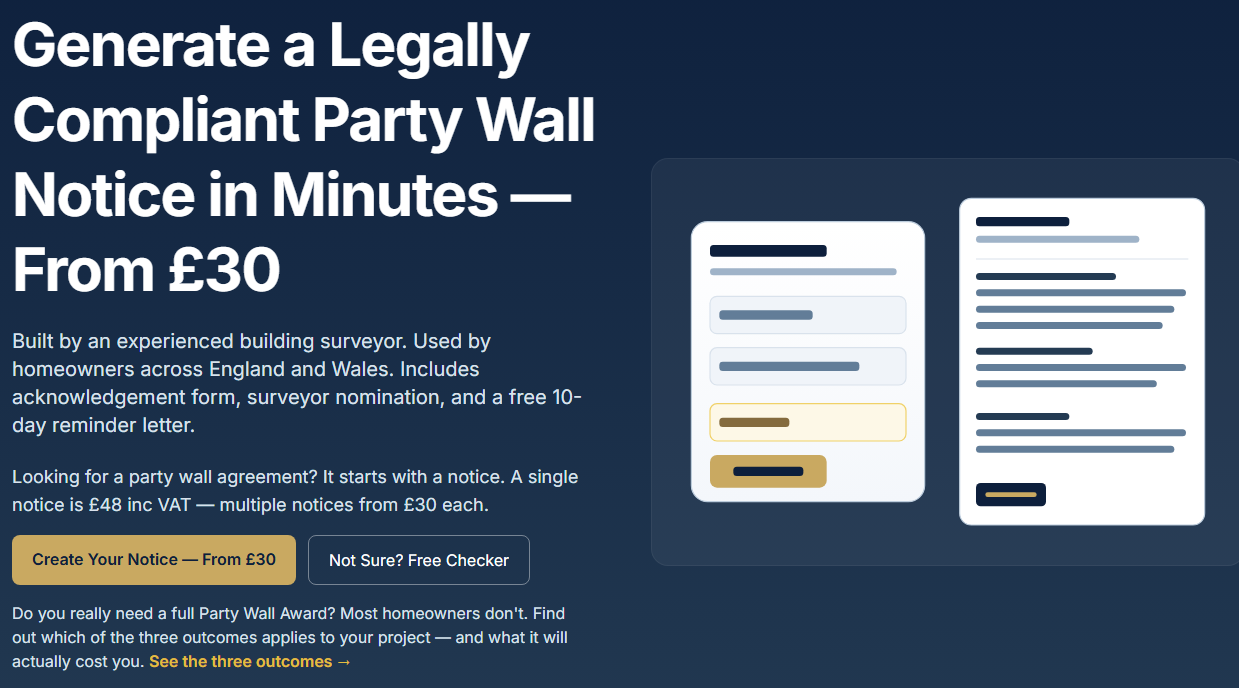
If you are the building owner and want help preparing the correct document, an online provider such as Party Wall Notices UK can guide you through the questions and generate a personalised notice pack. The provider says its plain-English process normally takes under ten minutes and includes a downloadable notice, adjoining-owner acknowledgement form, surveyor nomination details and a reminder letter.
Current advertised prices include VAT: £48 for one notice, £36 each for two or three notices, and from £30 each when four or more notices are required. You can also use its free checker if you are unsure which notice applies.
Create or check your Party Wall Notice online →
An online generator can simplify preparation, but the building owner remains responsible for providing accurate project and ownership information, using the correct notice and serving it properly. Complex, disputed or unusual work may require advice from a suitably experienced party wall surveyor or solicitor.
Authoritative sources and further help
Read the official GOV.UK explanatory booklet and the Party Wall etc. Act 1996 on legislation.gov.uk. For the wider process see our building owners guide, adjoining owners guide and notice guidance.
Reviewed: 16 July 2026. Seek advice from a suitably experienced party wall surveyor or solicitor where the facts or legal position are disputed.